




Sunny Skies for Now
The Malaysian economy has been having a notably good year. Despite headwinds from tariff-related uncertainty, economic growth surpassed expectations in 2025, with full-year growth clocking in at 5.2%, several points above the projected 4.0 – 4.8% growth rate. This was sustained with a respectable 5.4% in Q1 of 2026 and full year growth this year is expected to reach 4 – 5%.
The factors underpinning strong economic performance are manifold – strong domestic consumption, investment and export growth, and higher tourism receipts all contributed.[1] Malaysia’s electronic exports in particular are worth highlighting; exports in the electrical and electronic products category, which includes semiconductors, constituted almost 50% of total exports last year.
The outlook for 2026 is more complex. Rising fuel prices have put pressure on the budget, as the government has sought to keep long-standing fuel subsidies largely intact while reforming the subsidy program for a more targeted approach. This is a political decision: the last government that tried to remove fuel subsidies and raise revenue through a broad Goods and Service Tax was voted out, ending 61 years of dominance by Barisan Nasional.[2] Nevertheless, in the few months since the Iran war started, Malaysia has weathered the oil crisis relatively well, in part due to domestic oil production and a strong fiscal position.
But Rough Weather Ahead
While the economy may be going relatively well, upcoming state elections, and potentially early general elections, loom large on the horizon. The current government is an uneasy collection of coalitions and PM Anwar Ibrahim’s coalition, Pakatan Harapan (PH), has not performed well in recent by-elections and state elections. PH and its partner in government, Barisan Nasional (BN), have indicated that they may contest the next general elections separately, as competitors.
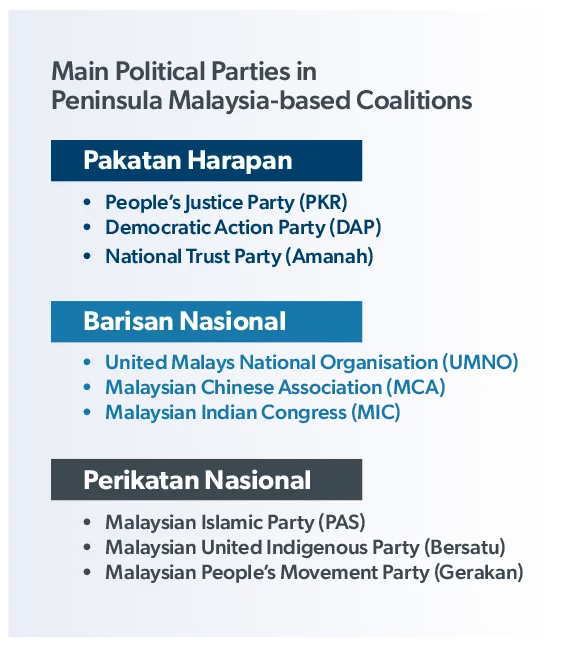
As of June 2026, of the various parties that are contenders in Malaysia’s political landscape[3], UMNO, which dominates BN, appears to be the strongest:
- PH has been buffeted by several scandals including allegations of corruption against a former key aide to Anwar, alleged corrupt activity in one of PH’s key allies, and multiple accusations concerning the anti-graft agency. Parties in the coalition are also dealing with internal rifts, the most notable of which has led to two PKR lawmakers – both former ministers – resigning from their seats and relaunching a small political party as their renewed political vehicle.
- The two parties that dominate Perikatan Nasional, the opposition bloc – Bersatu and PAS – have been at odds with each other. In a recent escalation, PAS severed ties with Bersatu and held talks with UMNO; the two Malay-oriented parties have been episodic partners when convenient but mostly rivals. An alliance of the two parties in the next general elections could shift power away from PKR and its centrist allies that, in principle, espouse a more multicultural approach.
As it currently stands, UMNO appears likely to revisit its position as kingmaker in the next general elections and, depending on where the cards fall for PH and PN, it may be strengthened enough to command the premiership.
There are many potential political configurations in the next general elections, some of which have broad social consequences. If PAS, UMNO and Bersatu, or any combination of the three, patch over their rivalries to form a strong Malay-Muslim-led bloc, Malaysia could see its first defacto[4] multi-ethnic-versus-Malay-nationalist contest in decades – a polarising contest that could deepen divisions in the multicultural society. If, instead, PH and BN go their separate ways at the polls without a broader realignment that draws in PAS or Bersatu, the most likely outcome is another fragmented parliament in which no coalition commands a clear majority, as was the case in 2022. A third possibility could see PAS and UMNO teaming up against PH, with Bersatu on its own, resulting in multi-cornered contests in many electorates. At best, this would result in another King-mediated coalition of coalitions as was the case in 2023. At worst, it would force a return to the inherently unstable situation that resulted in two changes of government between 2020 and 2022.
Who Watches the Watchers?
Coalition alignments are not the only factor shaping how upcoming elections play out. Anwar has long positioned himself as an advocate for good governance but developments around the Malaysian Anti-Corruption Commission and, more importantly, the government’s response, have dented his reformist credentials.
The MACC is no stranger to controversy, but public perception of the anti-corruption body reached a nadir in early 2026, resulting in calls for a Royal Commission of Inquiry (RCI) into the agency from civil society groups as well as members of the PH coalition itself. At the centre of the concerns raised by proponents of a RCI were two allegations in a Bloomberg exposé: that MACC’s then-chief held shares in a listed company that were well over the limit that applied to civil servants’ ownership of local companies, and that agency officers colluded with businessmen to pressure principals of companies into takeovers via staged investigations.[5]
The response from the government could be described as half-hearted at best: an investigation into the shareholdings was launched and the former MACC chief, who retired in May, was eventually cleared of misconduct. Three agencies – including the MACC itself – were tasked with investigating the alleged collusion with the so-called “corporate mafia,” but no findings have been announced to date. The mild response to potential abuses of power in an agency that is meant to investigate and prosecute similar misconduct runs the risk of alienating a section of PH’s supporters.
A Fiscal and Political Quandary
Despite political shenanigans, economic indicators are generally more positive than negative: besides strong GDP growth, the unemployment rate has hovered around 3% in recent years, and the ringgit (MYR) has been one of the best-performing currencies in Asia this year, at one point reaching highs above the US dollar that would have been considered unthinkable only three years ago.
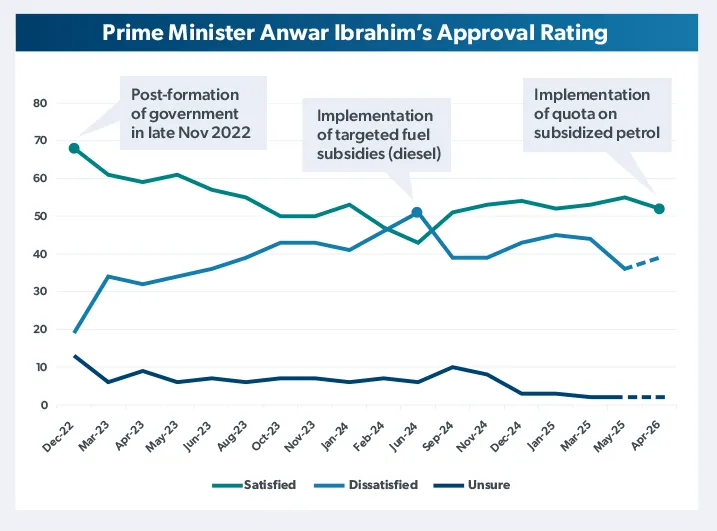
Anwar’s approval rating also appears to have held up despite the challenges: independent pollster Merdeka Center put his approval at 54-55% at the mid-term mark in May 2025.[6] Yet-to-be-released results of the latest Merdeka Center survey, conducted in April 2026 – after both the start of the Middle East crisis and the MACC scandal – indicate that his approval rating is down slightly but remains above 50%.[7]
What might upset the applecart is the on-and-off conflict in the Middle East and the subsequent impact on fuel prices, inflation, and general economic uncertainty, which remain top concerns among voters.[8] The closure of the Straits of Hormuz hit Asian countries hard and the cost of maintaining fuel subsidies has multiplied from MYR 700 million (US$ 172 million) a month at the start of the year to a peak of MYR 7 billion (US$ 1.7 billion) in April. This is expected to moderate slightly to MYR 3.5 – 4 billion (around US$ 900 million) per month but the subsidy bill remains enormous.[9]
On the fiscal side, this raises the possibility that the government could miss its deficit target this year. Additionally – and this is crucial to general elections calculations – inflationary pressures that affect costs of living are likely to escalate if the conflict remains unresolved. While fuel subsidies shield Malaysians from the impact of oil price hikes at the petrol pump, higher oil prices will eventually be felt by households as the cost of logistics and petrochemical feedstocks increase. An increase in daily costs, regardless of origin, could translate to unhappiness with the Anwar administration at the ballot box.
The irony is that the same global crisis that has so far validated the PH-led government’s macroeconomic management could just as easily become the reason its targets – fiscal and political alike – slip out of reach.
Malaysia’s ever-changing political constellations underscore the importance of knowing a potential business partner’s political connections. Such connections can be both beneficial and detrimental as the landscape evolves.
If you have any questions or would like to discuss how we can help, reach out to Jeen Loo or Jason Liew.
To receive StoneTurn Insights, sign up for our newsletter.
[1] https://www.bnm.gov.my/-/qb25q4_en_pr
[2] The 1MDB scandal was likely to be a contributing factor, causing widespread unhappiness in 2018.
[3] This article focuses on the parties and coalitions that hold sway over Peninsula Malaysia politics. A different set of parties are the main contenders in East Malaysia and these form alliances with the Peninsula-based coalitions.
[4] Both Barisan Nasional, the coalition that UMNO leads, and Perikatan Nasional, which currently includes PAS and Bersatu, have minor constituent parties that either seek to represent the interests of ethnic minorities or promote more multicultural views but these parties have lost broad support from their traditional bases, which have shifted their support to PH in the last few elections.
[5] https://www.bloomberg.com/news/features/2026-02-11/malaysia-macc-allegedly-working-with-businessmen-to-seize-control-of-companies
[6] https://merdeka.org/mid-term-survey-may-2025-report-final/
[7] https://www.themalaysianist.com/p/anwars-approval-rating-slips
[8] https://merdeka.org/mid-term-survey-may-2025-report-final/
[9] https://www.thestar.com.my/business/business-news/2026/06/09/west-asia-crisis-pushed-malaysias-fuel-subsidy-bill-to-rm75bil-in-april
Disclaimer: The views expressed in this article are those of the author and do not necessarily reflect the views of StoneTurn Group, LLP, Province, LLC, or their affiliates. This article is provided for informational purposes only and does not constitute legal, financial, or other professional advice.