

A Downward Spiral
Going by FDI numbers, 2025 was a good year for Thailand. The country recorded a 42% year-on-year increase in approved FDI, significantly outperforming its regional peers[1] in this metric and, at THB 1.14 trillion (US$ 35 billion) in value, this marked the strongest performance in five years.[2] Much of this increase was driven by data centre investments and EV-related project approvals.
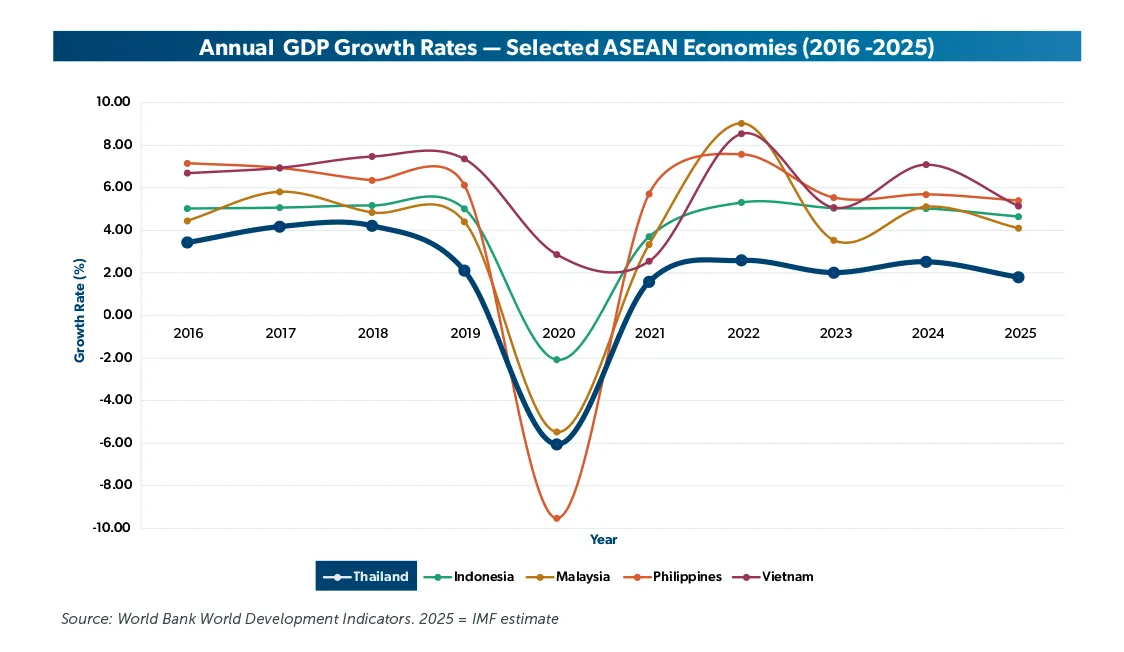
While FDI figures paint a rosy picture, the broader economy has been gradually slowing down over the past three decades. Thailand’s annual GDP growth rate has gone from averaging just over 7% in the mid-1990s to around 5% before the global financial crisis of 2008, and 3.2% in the pre-Covid decade. In the post-pandemic era, annual GDP growth has hovered between 1.9 – 2.9%.[3] The ongoing conflict in the Middle East, which has put a damper on tourism (one of the economy’s main drivers) and is driving up inflation, is just the latest blow to the economy.
The notable slowdown in Thai economic growth cannot be attributed to purely external factors, particularly when its neighbours have endured similar challenges.
Structural factors such as an aging and stagnant population,[4] high household debt, and low productivity play a key role and have been exacerbated by decades of institutional erosion: two military coups, 10 prime ministers (not including acting Prime Ministers), and four constitutional rewrites since 2001 have made political continuity something of a unicorn in Thailand.
The country’s chronic political instability has consequences that compound over time: long-term infrastructure planning stalls, policies and priorities shift with each new administration, and the business environment rewards those with connections to power and influence. It is this environment where informal networks matter more than institutions that allowed a figure like Benjamin Mauerberger to embed himself so deeply.
Benjamin Mauerberger: From Access to Arrest Warrant
The Mauerberger affair may be the most striking example of how porous Thailand’s institutions have become. Mauerberger, a South African businessman who reportedly started out running scam operations more than two decades ago, allegedly infiltrated Thai and Cambodian government circles in a case that has drawn comparisons to the Jho Low – 1MDB scandal. Two former journalists from The Wall Street Journal allege that Mauerberger sat at the centre of a sprawling Chinese-Cambodian criminal network, laundering hundreds of millions of dollars while paying bribes to Thai politicians and bureaucrats. Based on public photos, Mauerberger’s social circle appeared to include Thaksin Shinawatra, Prime Minister Anutin Charnvirakul, two Deputy Prime Ministers[5], a former army chief, and a former police inspector-general.[6] When the journalists published reports on these connections, the initial response from parts of the Thai establishment was not an inquiry, but the threat of a lawsuit. At least two of the politicians who allegedly had close ties to Mauerberger said they would file defamation lawsuits.[7]
After it emerged that Mauerberger may be subject to U.S. sanctions (he is listed in a draft bill on foreign scam syndicates), the tone shifted.[8] Mauerberger now stands accused of fraud and money laundering and an arrest warrant for him was issued in February 2026. Thai and Singapore authorities have collectively seized more than THB 20 billion (US$ 618 million) and SG$ 160 million (US$125 million) in assets linked to his network, although Mauerberger has fled the country. Politicians who had been photographed with Mauerberger now say they were merely acquaintances.
The High Cost of Corruption
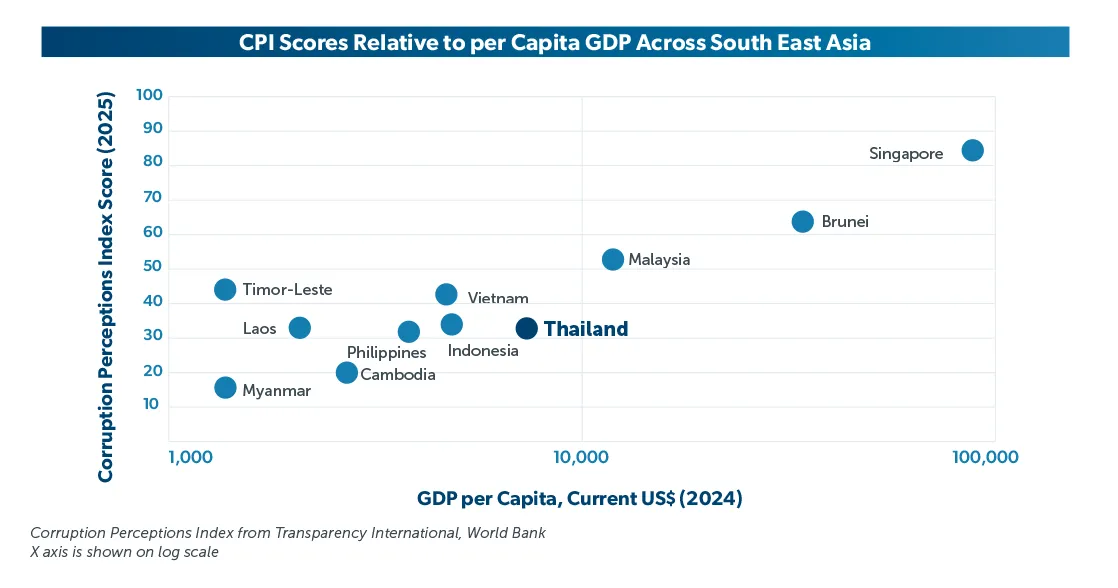
The Mauerberger case is a symptom of wider, institutional weaknesses in the Land of Smiles. Despite ranking as the 4th highest Southeast Asian country in per capita GDP, Thailand’s score on the Corruption Perceptions Index is among the lowest in the region.[9] In 2025, Thailand’s CPI ranking fell to 33 out of 100 in 2025, below Vietnam, Indonesia, and Laos, and just ahead of Myanmar, Cambodia, and the Philippines. The Anti-Corruption Organization of Thailand estimates that corruption costs the economy around 2% of GDP and that bribes account for 20 – 30% of public procurement costs.[10]
The financial system has reflected these same weaknesses: Thailand was placed on the Financial Action Task Force’s (FATF) list of jurisdictions with AML deficiencies in 2010 and while it exited that list in 2013, the Mauerberger affair suggests that there are still significant underlying vulnerabilities that need to be addressed.[11] Business leaders have warned that without tackling corruption alongside economic stimulus, Thailand risks becoming a conduit for grey capital where illicit financial flows undermine legitimate growth and distort the economy.[12]
Bridges, Bills, and Bhumjaithai
It was against this backdrop that general elections were held in February 2026. The Bhumjaithai party, led by incumbent Prime Minister Anutin, came out on top, more than doubling their seat count from the previous elections. Bhumjaithai had hitherto been a relatively small party and only a junior member of the ruling coalition, but it has now displaced both the youth-driven People’s Party and Thaksin’s Pheu Thai party as the largest bloc of seats in Parliament. PM Anutin, who had put technocrats at the centre of his election campaign, now holds the enviable record of being the first incumbent to win an election in two decades.
With this mandate, and against the backdrop of soaring fuel prices, PM Anutin has made economic reform his top priority. His policy statement to Parliament centred on growth, debt relief, and reducing business costs, anchored by an omnibus bill to scrap outdated regulations and a “super licence” law to streamline investment approvals, in addition to debt resolution efforts.[13]
The centrepiece of the longer-term agenda is the Land Bridge: a proposed transport corridor across the southern isthmus linking deep-water ports in Ranong and Chumphon that would offer an alternative to the Straits of Malacca, which is one of the most important shipping lanes in the world. Geopolitical events have given the project fresh urgency as the disruption to global shipping from the Middle East conflict has lent credibility to the case for alternative routes.
Mixed Signals: Political Expediency vs Principles
PM Anutin’s announced measures, if successful, will go some way towards addressing Thailand’s economic malaise but the country’s institutional weaknesses need to be thoroughly addressed. Fortunately, regulators have not been idle. In the months since the Mauerberger scandal broke, the central bank, the SEC, and the Anti-Money Laundering Office (AMLO) have introduced stronger risk management requirements to prevent money laundering and increase oversight over cryptocurrency transactions.[14] In particular, the AMLO expanded its definitions of Politically-Exposed Persons significantly to cover not just current officials but former office-holders that retain influence or close relationships with current political office-holders.[15]
While these measures are a positive sign, it is unclear if Mauerberger’s Thai associates and alleged facilitators will face any consequences: the South African’s most influential connections – including two current ministers – have not been subject to visible action.[16] It would appear that the crackdown has targeted the money while leaving the network’s domestic enablers untouched for now.
Economic stimulus will not fully work if corruption is not comprehensively and simultaneously addressed. The FDI numbers of 2025 are a bright spot, and PM Anutin’s reform agenda, if delivered, would mark real progress. However, the record of the Mauerberger affair is a reminder that Thailand’s most stubborn economic problem cannot be solved with infrastructure projects or legislation alone. It requires the political will to hold the system’s beneficiaries accountable, regardless of influence. Whether this administration will make its mark by cleaning up remains to be seen.
| The Mauerberger affair highlights the need for firms entering a new partnership or business arrangement to fully understand their counterparty’s business, network, and, in some cases, source of wealth. It also showcases how licensed fund management companies in “safe” jurisdictions can be misused. |
If you have any questions or would like to discuss how we can help, reach out to Jeen Loo or Jason Liew.
To receive Insights, sign up for our newsletter.
Disclaimer: The views expressed in this article are those of the author and do not necessarily reflect the views of StoneTurn Group, LLP, Province, LLC, or their affiliates. This article is provided for informational purposes only and does not constitute legal, financial, or other professional advice.
[1] We reviewed full-year FDI inflows for the key middle-income economies of Indonesia, Malaysia, Philippines, Thailand, and Vietnam.
[2] https://www.boi.go.th/upload/content/FDI%20Q4%202025%20final_697c54284c65e.pdf
[3] https://tdri.or.th/en/2026/03/structural-challenges-for-the-thai-economy/
[4] Reports on population growth vary but the resident population (including non-Thai residents) appears to be stagnant at best.
[5] One of the DPMs, Thammanat Prompao, is not part of the current government.
[6] https://www.bangkokpost.com/thailand/general/3150070/old-ben-smith-photos-come-back-to-haunt-thai-vips; https://www.asiasentinel.com/p/thaksin-shinawatra-mystery-fixer-man-benjamin-mauerberger
[7] https://asianews.network/thai-deputy-pm-threatens-billion-baht-lawsuits-over-scammer-links/
[8] https://www.congress.gov/bill/119th-congress/house-bill/5490/text
[9] There is a negative correlation between per capita GDP and corruption perceptions. Some references: https://www.sciencedirect.com/science/article/abs/pii/S0176268019301156; https://www.elibrary.imf.org/display/book/9781589061163/ch008.xml
[10] https://www.bangkokpost.com/opinion/opinion/3197618/corruption-keeps-getting-worse
[11] https://www.fatf-gafi.org/en/publications/Fatfgeneral/Compliance-june-2013.html
[12] https://www.nationthailand.com/business/economy/40063977
[13] https://image.mfa.go.th/mfa/0/mkKfL2iULZ/สำนักนโยบายและแผน_(สนผ_)/Policy_Statement_Anutin_EN.pdf
[14] https://www.nationthailand.com/business/banking-finance/40063826
[15] https://www.bangkokpost.com/thailand/politics/3150829/amlo-widens-scope-of-politically-exposed-persons
[16] https://world.thaipbs.or.th/detail/korn-raises-concerns-over-cabinet-ties-to-alleged-scam-network/60968