




Prior to its cessation, arbitral tribunals routinely relied on LIBOR when awarding interest to ensure full compensation. Indeed, a 2022 Global Arbitration Review[1] analysis of ICSID awards issued between 1988 and 2020 found that approximately one‑third of all awards applied LIBOR, making it the most commonly used reference rate during that period. Since commercial awards are generally confidential, publicly available data on interest is necessarily drawn from Investor–State arbitrations. However, while treaty cases can feature state-specific factors, both commercial and investment tribunals share the same underlying goal: restoring the injured party to the position it would have occupied had the breach not occurred. As such, trends in treaty cases can therefore offer valuable guidance on how commercial arbitrators are likely to approach an award of interest.
Sterling, Swiss franc, Japanese yen and Euro LIBOR were discontinued at the end of 2021 and US dollar LIBOR ceased in June 2023. Synthetic LIBOR settings continued for a period afterwards to give the business community time to transition, but by the end of September 2024 these had ended for all currencies[2].
With the discontinuation of LIBOR, the question naturally arose as to what benchmark tribunals would adopt in its place. In late 2021, the UK Financial Conduct Authority confirmed that financial markets had already transitioned to the new family of (nearly) risk‑free rates, including SONIA, SOFR and €STR[3]. Commentators in the arbitration community speculated whether tribunals would follow suit, while acknowledging that these benchmarks are not perfect substitutes: they do not incorporate the same term bank credit or liquidity premium as LIBOR and therefore tend to produce lower rates[4].
To understand how tribunals have responded in practice, this article reviews publicly available Investor–State awards published on italaw[5] from January 2024 to July 2026.[6] Of these, 25 awarded damages and contained sufficient detail to understand how the relevant tribunals approached the question of interest.
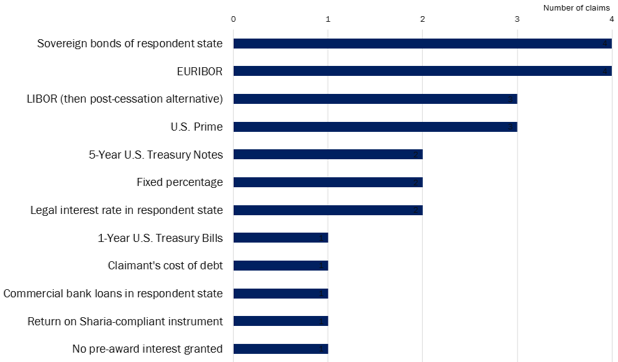
The results, summarised below, indicate that no single alternative has emerged as a clear successor to LIBOR. Instead, tribunals have adopted a range of approaches, often taking care to explain the party‑specific and fact‑specific reasons why a particular benchmark best serves the principle of full reparation in the circumstances of each case.
Figure 1: Pre-award interest rates, January 2024 to July 2026
What has filled the LIBOR Void? Emerging Favourites
Across the awards reviewed, no single benchmark has stepped into LIBOR’s shoes. Instead, tribunals have gravitated toward a handful of alternatives — most prominently sovereign bond rates and EURIBOR[7] — each selected for reasons closely tied to the facts and parties in dispute.
Sovereign borrowing rates have gained traction where tribunals consider counterparty risk central to full reparation. In Odyssey Marine Exploration v. Mexico[8], the claimant argued for a rate “equivalent to the WACC[9] of a typical investor in a pre-operational mining project in Mexico”. The tribunal disagreed, stressing that damages in the arbitration had not been exposed to mining business risk after the valuation date. It also rejected the respondent’s proposal for the rate on U.S. Treasury bills, noting that this didn’t adequately reflect the counterparty risk as the debtor was Mexico, not the United States. The tribunal ultimately selected the one‑year Mexico Treasury bond rate, compounded annually, as the best reflection of the time value of money and the relevant counterparty risk.
A similar logic drove the tribunal in Diamante Trading and others v. Venezuela[10]. The tribunal declined to apply the expropriated business’ cost of capital, noting that doing so would overcompensate for risks the claimants did not bear after being dispossessed. Persuaded by the claimants’ characterisation of themselves as involuntary lenders to the state, the Tribunal also rejected a risk‑free rate, saying that involuntary lenders should not be treated any worse than voluntary lenders (who would expect a return above a risk-free rate). The appropriate benchmark, it held, was a rate equivalent to Venezuela’s sovereign borrowing cost.
While sovereign borrowing rates reflect state credit risk and are not directly applicable to private parties, commercial tribunals may take a similar approach and look to reflect the respondent’s specific credit risk in an interest award.
EURIBOR has also emerged as a popular benchmark, particularly where treaties call for a commercial, market‑based rate. In LSG Building Solutions and others v. Romania[11], the tribunal found that 12-month EURIBOR, widely used in interbank lending across the EU, met the treaty’s market‑basis requirement. To satisfy the commercial rate qualifier, the tribunal added a 3% margin to reflect an appropriate commercial spread.
How Tribunals Are Handling LIBOR’s Legacy
It will not have escaped notice that as set out in Figure 1, LIBOR still features in three of the awards issued during the period. These decisions offer useful insight into how tribunals have managed the transition away from LIBOR and, in particular, differing approaches to spread adjustments when replacing LIBOR with (nearly) risk-free alternatives.
In Lupaka v. Peru[12], the tribunal applied LIBOR + 4% until its cessation on 30 June 2023 before transitioning to U.S. Treasury bills + 5%. In prescribing that a higher spread should be added to the U.S. Treasury bill rate, the tribunal seemed to have taken on board the arguments made by the claimant’s damages expert that LIBOR reflects a higher level of risk, and as such, a higher spread must be applied to the U.S. Treasury bill rate to reflect a comparable risk profile.
A different approach was taken in Niko Resources v. Bapex[13]. The tribunal initially awarded interest at LIBOR + 2% on USD damages but acknowledging that LIBOR would be discontinued, it ordered that LIBOR be replaced by SOFR + 2% going forward. That substitution raises an important issue: SOFR does not replicate LIBOR’s risk profile. It is a secured, nearly risk-free rate and does not incorporate the credit or liquidity premium embedded in LIBOR. As a result, replacing LIBOR with SOFR while maintaining the same 2% spread may produce a lower overall rate than the original LIBOR-based benchmark.
Use of Spreads to Preserve Commercial Reality
As we have seen, tribunals frequently add a spread to the risk-free or low-risk benchmark rate awarded. In Veolia v Italy[14] the tribunal explained that EURIBOR serves merely as a baseline for compensating the time value of money which does not necessarily reflect the value lost by a company deprived of the use of its own capital. This, it noted, explains why tribunals often award a benchmark rate plus a reasonable premium. In that case, the tribunal applied EURIBOR + 2%, observing that a 2% uplift in addition to a benchmark rate “has been a commonly referenced interest rate by tribunals.” This is consistent with our review: eight awards added a spread to the benchmark rate used (including EURIBOR, SOFR and the U.S. Prime Rate), and six of those applied a 2% spread.
Compound Interest as the Default
Tribunals also show a clear preference for compound interest. In over three quarters of the cases reviewed, compound interest, typically compounded annually, was awarded, with tribunals emphasising that the principle of full reparation requires it.
In the cases where simple interest was awarded, the tribunal did so because:
- the respondent State’s domestic law generally prohibited compound interest;
- the claimant had not requested compound interest; or
- the claimant failed to justify why compound interest was necessary to achieve full reparation beyond asserting that it better reflects the time value of money.
No pre-award interest
A notable exception to the general trend of awarding pre-award interest, and one that appears to turn on the specific facts of the case, is Glencore v. Colombia (II)[15]. The tribunal held that interest should accrue only from the date of the award, pointing to the “Claimants’ comparative fault” as a reason for that approach.
Post‑Award Interest: Divergent Approaches
In most of the awards reviewed, tribunals applied the same rate for pre‑ and post‑award interest. Only four cases departed from this approach. In Energía y Renovación v. Guatemala[16], the tribunal applied the yield on 5‑year U.S. Treasury notes for pre‑award interest but switched to U.S. Prime Rate + 2% for post‑award interest. It reasoned that applying the pre‑award rate to the post-award period might reduce the incentive for prompt payment and therefore considered a higher post-award rate appropriate.
By contrast, in Strabag and others v. Germany[17], the tribunal did not consider it appropriate to fix post-award interest at a higher rate to incentivise compliance, stating that it “must assume that, in accordance with its agreement to arbitrate as determined by the Tribunal, the Respondent will comply with the Award”. This illustrates that tribunals diverge on whether post‑award interest should serve a compensatory function alone or also a behavioural one.
Why Interest Matters
If one theme emerges from this analysis, it is that the post‑LIBOR interest landscape is highly varied. Tribunals are engaging closely with the facts, the parties’ circumstances, and the economic rationale underpinning an award when determining interest. Against that backdrop, any party that treats interest as an afterthought does so at its peril. The tribunal in Energía y Renovación v. Guatemala[18] explicitly noted that the parties devoted little attention to the issue of interest, with the claimant devoting only two paragraphs to interest in its statement of claim and one in its reply, while the respondent said nothing at all in its principal legal submissions. This is striking given that interest often represents a substantial share of the total award. In Webuild v. Argentina, for example, the tribunal awarded approximately US$147 million, of which US$49.6 million—just over one‑third—was pre‑award interest, with post‑award interest accruing at 6% compounded annually.
With such large amounts at stake, it would seem – as has been observed before – it pays to take an interest in interest.
If you have any questions or would like to discuss how we can help, reach out to Victoria Middleton.
To receive Insights, sign up for our newsletter.
Disclaimer: The views expressed in this article are those of the author and do not necessarily reflect the views of StoneTurn Group, LLP, Province, LLC, or their affiliates. This article is provided for informational purposes only and does not constitute legal, financial, or other professional advice.
[1] https://globalarbitrationreview.com/guide/the-guide-damages-in-international-arbitration-archived/5th-edition/article/pre-award-interest
[2] https://www.fca.org.uk/news/press-releases/end-libor
[3] https://www.fca.org.uk/news/speeches/so-long-libor-3-weeks-to-go
[4] https://www.bankofengland.co.uk/-/media/boe/files/markets/benchmarks/rfr/what-is-credit-adjustment-spread-supporting-slides.pdf
[5] https://www.italaw.com
[6] Awards data accessed 10 August 2026.
[7] EURIBOR is administered by EMMI and is distinct from the former Euro LIBOR benchmark; it remains in active use following governance and methodology reforms implemented from 2019 through 2024 https://www.emmi-benchmarks.eu/benchmarks/euribor/reforms/
[8] Odyssey Marine Exploration, Inc. v. United Mexican States, ICSID Case No. UNCT/20/1, final award dated 17 September 2024
[9] Weighted Average Cost of Capital
[10] Diamante Trading Investments Ltd. and others v. Bolivarian Republic of Venezuela, PCA Case No. 2019-49, award dated 27 May 2025
[11] LSG Building Solutions GmbH and others v. Romania, ICSID Case No. ARB/18/19, award dated 20 February 2024
[12] Lupaka Gold Corp. v. Republic of Peru, ICSID Case No. ARB/20/46, award dated 30 June 2025
[13] Niko Resources (Bangladesh) Ltd. v. Bangladesh Petroleum Exploration & Production Company Limited (“Bapex”), ICSID Case No. ARB/10/11, award dated 18 December 2025
[14] Veolia Propreté SAS v. Italian Republic, ICSID Case No. ARB/18/20, award dated 26 September 2025
[15] Glencore International A.G., C. I. Prodeco S.A., and Sociedad Portuaria Puerto Nuevo S.A. v. Republic of Colombia (II), ICSID Case No. ARB/19/22, award dated 19 April 2024.
[16] Energía y Renovación Holding, S.A. v. Republic of Guatemala, ICSID Case No. ARB/21/56, award dated 31 March 2025
[17] Strabag SE, Erste Nordsee-Offshore Holding GmbH and Zweite Nordsee-Offshore Holding GmbH v. Federal Republic of Germany, ICSID Case No. ARB/19/29, award dated 18 December 2024
[18] Energía y Renovación Holding, S.A. v. Republic of Guatemala, ICSID Case No. ARB/21/56, award dated 31 March 2025